


Ball Bearing
Why choose us?
Your Leading Ball Bearing Supplier
Advanced Equipment
It has CNC machine tools, CNC grinders, punching machines, super-finishing machines and multiple automatic production lines.
Custom Service
We can customize customer branding. If the customer only needs to print the brand on the bearing, there is no MOQ and extra cost.
Rich Experience
Businesses all over the world, with an annual output value of 50 million.
Global Shipping
We can arrange FedEx or DHL shipping for small orders. We can arrange sea shipping for large orders, and you need to do import customs clearance.




What is Ball Bearing?
A ball bearing is a type of rolling-element bearing that uses steel balls to reduce friction and improve the efficiency of rotary motion between two rings
Advantages of Ball Bearing
Low friction
Ball bearings have a small contact area with the load, which results in low friction and smooth motion. This makes them ideal for applications that require speed
Versatile
Ball bearings can rotate on multiple axes and are designed to handle a variety of loads.
Durable
Ball bearings are made from high-quality materials and can withstand demanding conditions.
Low maintenance
Ball bearings have a simple design and require minimal maintenance.
Cost savings
Ball bearings reduce friction torque, which lowers operating temperatures and energy costs.
Long shelf life
Ball bearings have a low operating temperature and low friction, which means they have a longer expected shelf life.
Types Of Ball Bearing

Self-aligning ball bearings
Have an inner ring with deep grooves and two rows of balls, which makes them immune to misalignment between the shaft and the housing
Deep groove ball bearings
Have deeper grooves than other types of ball bearings, which allows the balls to roll on more of the groove wall and transfer loads in more directions
Angular contact ball bearings
Use axially asymmetric races to support combined loads, or loading in both the radial and axial directions
Thrust ball bearings
Come in two types: single-acting, which has one row of balls, and double-acting, which has two rows of balls
Thin section bearings
These bearings have a smaller cross-section, which makes them ideal for high-speed, weight-sensitive, and space-limited applications
Flanged bearings
Have a flange on the outer ring, which makes them easy to mount onto a housing or shaft
Miniature bearings
Ideal for high-speed or limited space applications, these bearings are precise, reliable, and have low noise and vibration levels

Material of Chest Freezer?

Chrome steel
A common material for ball bearings, especially for precision miniature and instrument bearings. Chrome steel is used when corrosion resistance is not a major concern.
Stainless steel
AISI 440C stainless steel is a common choice for ball bearings that require corrosion resistance at room to mid-hot temperatures. It's the standard choice for many military and commercial applications.
Borosilicate glass
This glass is more chemical-resistant than soda-lime glass, and is used in applications that involve strong acids. It's also resistant to heat and temperature changes.
Plastic
Polymer-based ball bearings are lubrication-free, corrosion-free, and quiet. They're a cost-effective alternative to metal ball bearings.
Advanced alloys
For extreme operating conditions, more advanced alloys like BG42®, M50 NiL, and Cobalt-based alloys may be used.

Application Of Chest Freezer

Industrial:
Used in lathes, milling machines, presses, elevators, assembly lines, chain saws, power pumps, and more
Automotive:
Used in engines, transmissions, wheels, steering, electric motors, and gearboxes
Household:
Used in bicycles, skateboards, sewing machines, washing machines, tumble dryers, food processors, hair dryers, DVD players, and fishing rods
Office:
Used in fax machines, hard drives, fans, and air-conditioners
Aerospace:
Used in pulleys, gearboxes, and jet engine shafts on commercial, private, and military aircraft
Horology:
Used in watch movements to reduce thickness
Other:
Used in printing presses, textile machinery, and pumps
Medical: Used in medical and dental equipment

Process of Ball Bearing

Grinding the rings and balls
The rings and balls are ground to the desired size and shape using specialized grinding machines.
Lapping the balls
The balls are rolled between two hardened steel plates, with one fixed and one rotating at a low speed. This process improves the surface finish and geometry of the balls.
Assembling the bearing
The inner and outer rings, balls, and cage are assembled into a bearing.
Applying lubricant
Lubricant is applied to reduce friction and wear between the moving parts.
Making the rings
Steel wire or sheet is cut into round pieces, heated, and formed into rings. The rings are then machined to the desired size and shape.
Making the balls
Steel wire is cut into small, roughly spherical blanks. The blanks are then pressed into a mold at high speed to form smooth, uniform spheres. This process is called cold heading.
Hardening the rings and balls
The rings and balls are heated and hardened to increase their strength and durability.
Maintenance Tips for Ball Bearing
Handle with care:
Bearings are delicate and can be easily damaged if mishandled; avoid dropping them or applying excessive force.
Check housing and shaft:
Before installing a bearing, inspect the bearing housing and shaft for any signs of wear, damage, or contamination.
Proper mounting:
Use appropriate tools and techniques to mount the bearing correctly on the shaft to prevent misalignment and premature wear.
Lubrication:
Regularly apply the correct type and amount of lubricant to the bearing to reduce friction and wear.
Cleanliness:
Keep bearings clean by removing dirt, dust, and debris to prevent abrasive wear.
Avoid moisture:
Protect bearings from exposure to moisture and humidity, which can lead to corrosion.
Storage:
Store bearings in their original packaging in a clean, dry area to minimize contamination.
Inspect for damage:
Regularly check bearings for signs of wear like pitting, scoring, or excessive noise, which may indicate the need for replacement.
Use specialized tools:
When handling or installing bearings, use dedicated tools designed for the specific bearing type to avoid damage.
Replace when necessary:
If a bearing shows significant signs of wear or damage, replace it promptly to prevent further issues.
Our factory

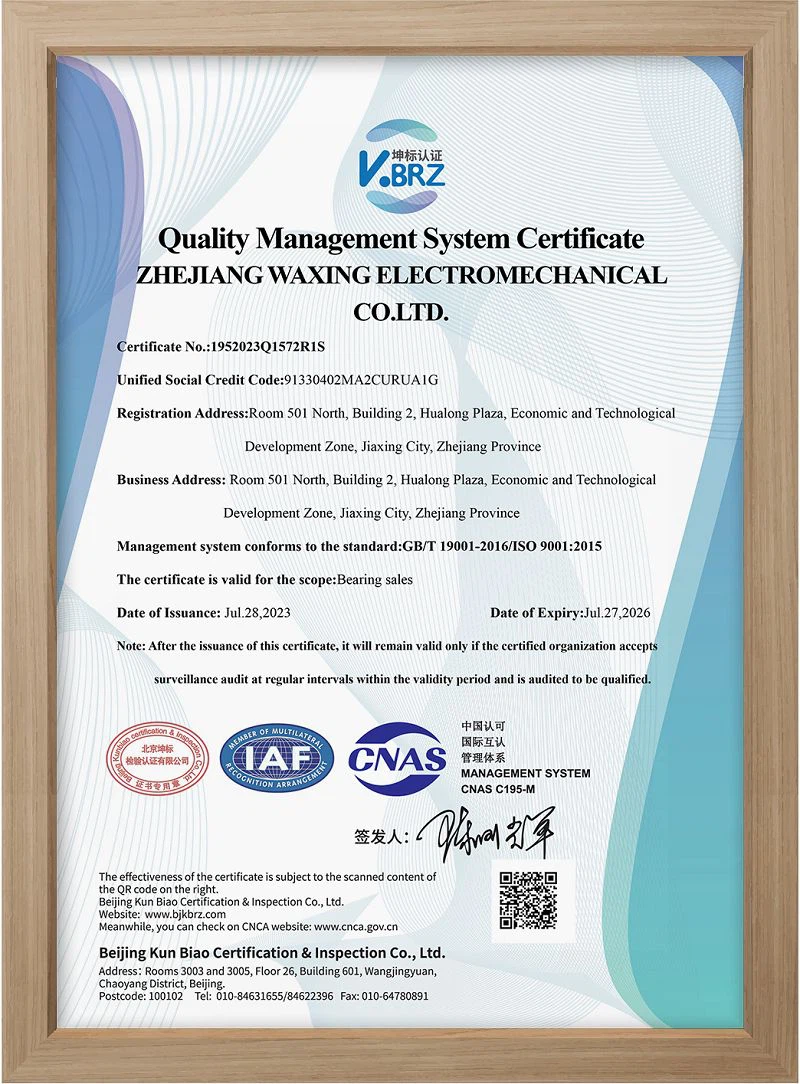
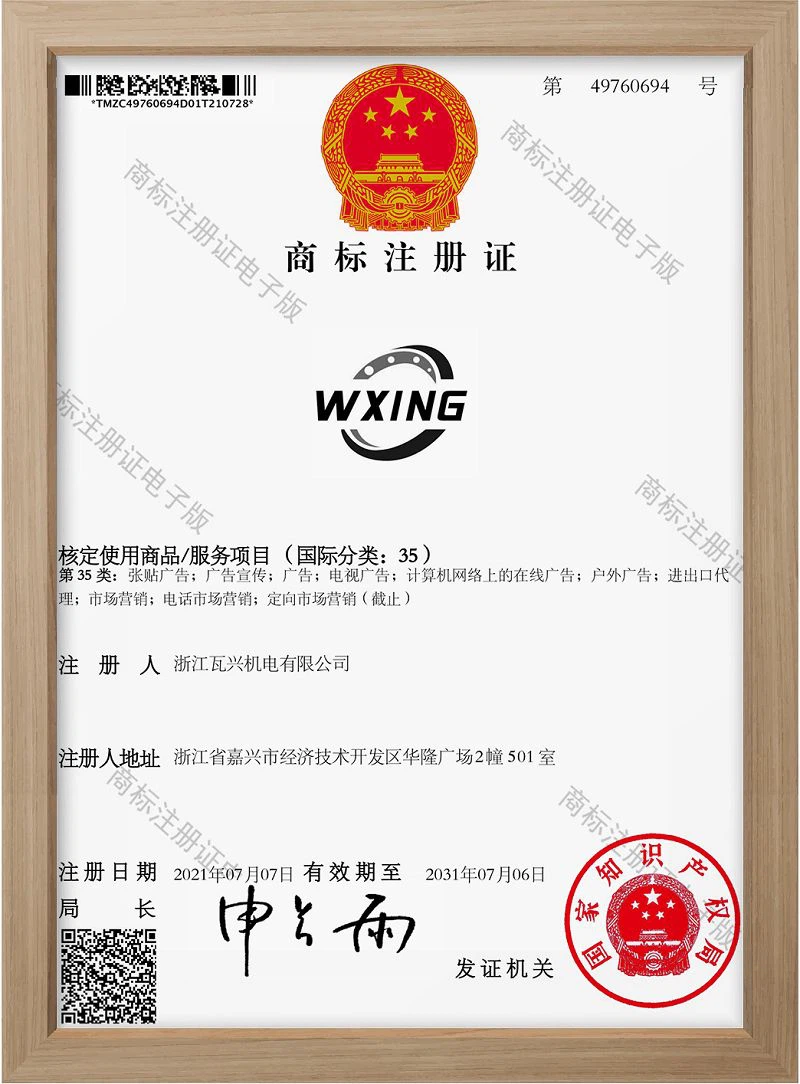
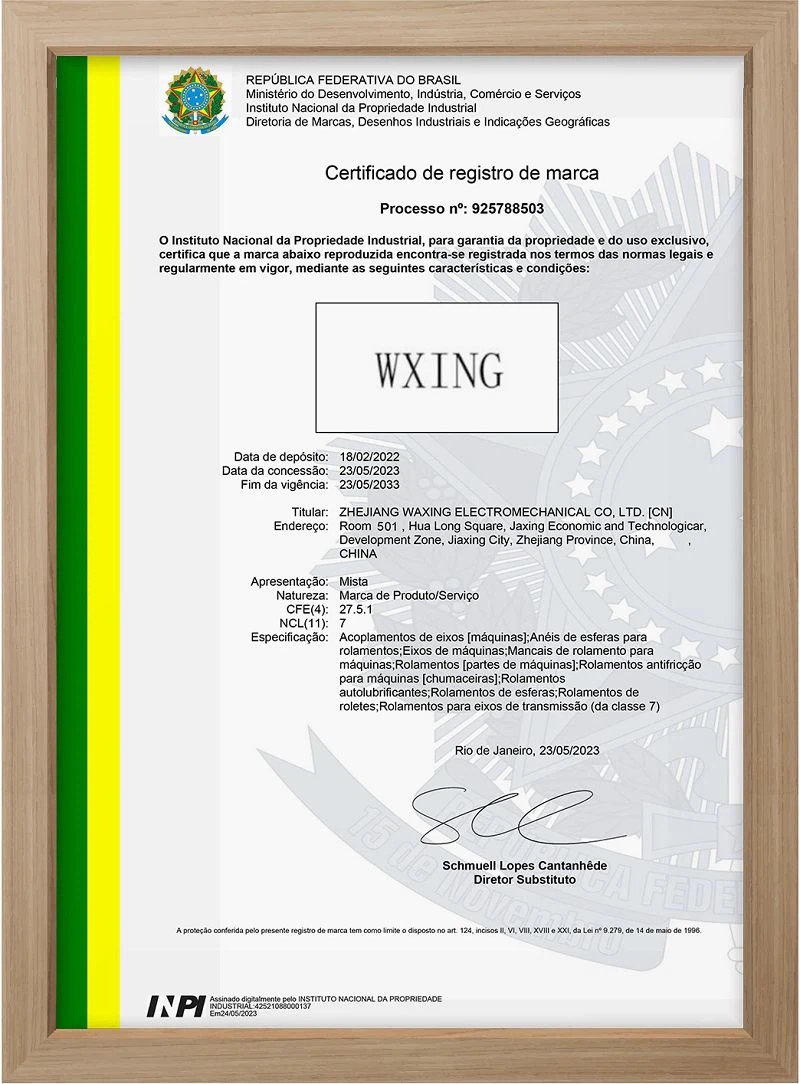
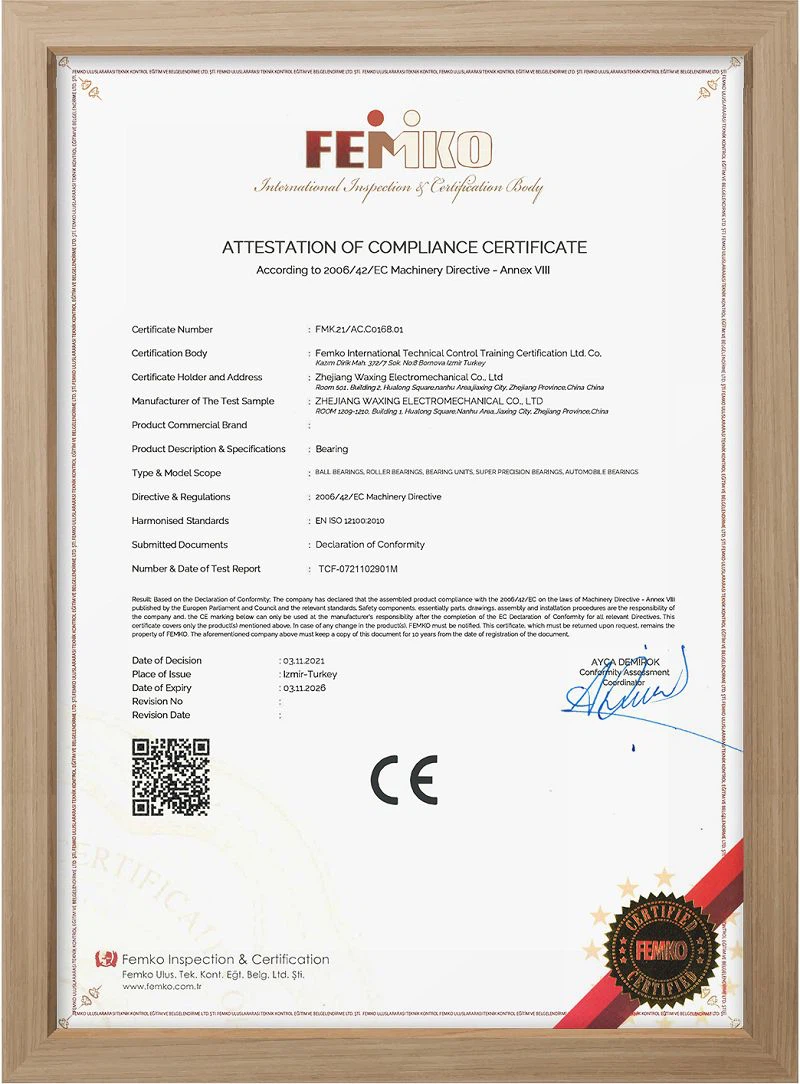
Our Certificate

EXHIBITION

FAQS
Q: Are you a bearings factory or a trading company?
A: We are a bearing factory.
Q: Where is your bearings factory?
A: Our factory is located in Linqing City, Shandong Province, China.
Q: What is the bearings lead time and production lead time?
A: Depending on the order quantity, the delivery time ranges from 3 days to 30 days. The lead time for customized bearings will be between 30 and 60 days.
Q: What is the factory's production capacity per month?
A: Our average monthly production capacity can reach 1 million US dollars.
Q: How is the quality of your brand compared with SKF, FAG and other brands?
A: Compared with the world's famous brands, our brand is very cost-effective. If the bearings are used on ordinary machines or products, our quality is similar, but our prices are cheaper. If used in high-precision instruments such as aerospace, we recommend that you use well-known brands such as SKF, because they represent the world's most advanced level.
Q: Do you have an office or dealer in Brazil?
A: No, we only have factories and export company in China.
Q: Can you customize branding for customers if they buy bearings from you?
A: We can customize customer branding. If the customer only needs to print the brand on the bearing, there is no MOQ and extra cost. If the customer needs to customize the color box, additional charges will be required. The cost of each size color box is US$150, 2000 boxes.
Q: Why are ball bearings used?
A: Ball bearings are used in machines which have lot of movement in their working process. Ball bearings reduce the friction during motion, so that efficiency of the machines is increased, and they move in a smooth manner.
Q: What is the principle of ball bearing?
A: Ball bearings rely on the principle of rolling contact. As the inner ring rotates, it transfers the load to the balls, which then distribute the load evenly around the bearing. This distribution of load reduces the pressure on individual points, minimizing wear and prolonging the bearing's life.
Q: Are ball bearings still used?
A: Ball bearings are commonly used for motors, pumps, conveyors, and gearboxes, where they reduce friction and support rotating parts under heavy loads.
Q: When to use a ball bearing?
A: Ball bearings are key components used in multiple industries to ensure efficient operation of machinery and systems. These mechanical devices reduce friction between moving parts, enabling smooth rotary motion and even load distribution.
Q: What are two examples of the use of ball bearings?
A: Ball bearings are used in cars,trucks and motor bikes.
Q: When should bearings be used?
A: Friction is bound to occur between the rotating shaft and the part that supports the rotation. Bearings are used between these two components. The bearings serve to reduce friction and allow for smoother rotation. This cuts down on the amount of energy consumption.
Q: How do ball bearings break?
A: The majority of bearing failures occur because of improper lubrication. Lubrication failure can occur if the wrong lubricant is used, if not enough lubricant is applied, or if the bearing has been exposed to excessive temperatures that have caused the lubricant to degrade. Corrosion & Contamination.
Q: How do you know if you need ball bearings?
A: Your wheel bearing might be bad if you hear unusual sounds like humming, squeaking, or clicking. Also, if your car wobbles or pulls to one side, you will want to get it checked. Wheel bearings are part of a car's suspension system and allow a car's wheels to turn with minimum friction.
Q: What is the most commonly used bearing?
A: Deep-Groove Ball Bearings are the most commonly used and feature in a wide range of different applications. Thanks to their simple design, they are easy to maintain and not sensitive to operating conditions. In addition to radial forces, they absorb axial forces in both directions.
Q: Why are ball bearings so expensive?
A: This is because much of the cost – 80% by some estimates – is set by the design. The components and materials used, and the manufacturing tolerances required, determine most of the final cost.
Q: Why are they called ball bearings?
A: Bearing balls are special highly spherical and smooth balls, most commonly used in ball bearings, but also used as components in things like freewheel mechanisms. The balls themselves are commonly referred to as ball bearings. This is an example of a synecdoche.
Q: Do bearings really make a difference?
A: Will new bearings make me faster? Yes - but not as much as you'd think. 95% of the time, your choice of wheel urethane will make way more of a difference to your speed than your bearings. On the other hand, if your bearings are rusted and crunchy, then a set of new bearings will make a huge difference!
Q: How do ball bearings fail?
A: In general, there are a handful of common reasons why bearings fail: Inadequate or improper lubrication. Contamination. Improper handling and installation.
Zhejiang Waxing Electromechanical Co., Ltd is well-known as one of the leading ball bearing manufacturers and suppliers in China, featured by quality products and competitive price. Please feel free to buy customized ball bearing made in China here from our factory.
Miniature Dental Bearing3 6 2mm, 4 point Contact Ball Bearing KA035XP0 P6 P0, Ball Bearings 608 ZZ1MC3 For Skateboard