

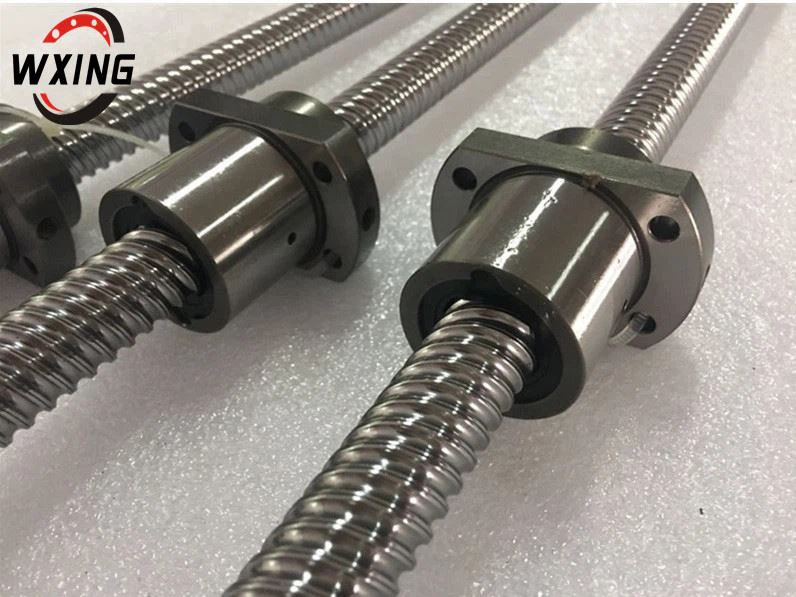
 Ball screw pair is composed of screw, nut, ball and other parts of the mechanical components.It will rotate the motion, change the linear motion, or change the linear motion to rotate the motion, have the advantages of high transmission efficiency, high positioning accuracy, transmission reversibility, long service life and good synchronization performance, so it is widely used in various industrial equipment, precision instruments and precision CNC machine tools.In recent years, ball screw pair, as the linear drive execution unit of nc machine tool, has been widely used in the machine tool industry, greatly promoting the development of the machine tool industry.
Ball screw pair used in various equipment, due to the different load, the force size is different, the screw work often bear bending, torsion, fatigue and impact, at the same time in the rotating part of the strong friction force, so its main form of damage is wear and fatigue failure.Therefore, the screw must have high strength and toughness, high surface hardness and wear resistance, as well as high dimensional stability and other internal performance requirements when it is designed and manufactured.Especially for large ball screw (diameter ≥ 80mm), due to the heavy load (dynamic and static load can reach nearly 1000kN), the requirements on strength and toughness, surface hardness and wear resistance are higher.At present, domestic manufacturers generally choose GCr15 steel, after spheroidizing annealing or tempering treatment and other pre-heat treatment, surface induction quenching heat treatment, in order to meet the inherent performance requirements of ball screw.
At present, large ball screw is generally quenched by intermediate frequency induction.In the production, it is often found that after the intermediate frequency quenching (tempering) lead screw grinding thread, after magnetic inspection, often appear in the thread raceway arc axial or network cracks, or even in the grinding thread process only by the naked eye can be found, resulting in the scrap of the lead screw.This not only causes direct economic loss to the enterprise, but also brings great pressure to the operators in the production line of the enterprise due to various factors causing the problem.The author has been engaged in the technical work of ball screw heat treatment for a long time, through the failure analysis and process tracing of the large number of grinding crack screw, the cause and control measures of this kind of crack are summarized, and the effectiveness is confirmed through mass production.
Reason analysis of grinding crack of screw rod after medium frequency quenching
1. Poor raw materials
The main performance of GCr15 is that the net carbide level is out of tolerance or the spheroidized annealing structure is unqualified (with flake pearlite).Based on the analysis of the non-uniformity and microstructure of the cracked lead screw, it is found that 40% of the total lead screw is out of tolerance of the net carbide or unqualified in spheroidization annealing.The non-uniformity of carbide results in uneven distribution of surface hardness and internal stress on the lead screw after induction quenching, and the internal stress in the parts where carbide is concentrated is also concentrated.When the screw rod is grinding, the grinding crack will occur because the internal stress of the screw rod exceeds the yield strength of the material.The existence of flake pearlite will result in the coarse grain of the lead screw after the surface induction quenching, which will reduce the yield strength of the steel. During the lead screw grinding, the grinding crack will occur at the part where the internal stress exceeds the yield strength of the material.
2. Screw medium frequency quenching heat treatment is not good
The main performance is high quenching temperature or insufficient tempering.Through analysis and statistics, the lead screw which caused the lead screw grinding crack accounts for about 20% ~ 30% of the total number.
When large ball screw is quenched at intermediate frequency, the output power of intermediate frequency is too high and the quenching speed is too slow, which may make the temperature of the screw during quenching on the high side, and the martensite organization level of the screw after quenching is off the upper limit (martensite level 5), and may even exceed the standard (martensite level ≥5).The large martensite structure reduces the steel content by 40 %.The grinding process parameters of the screw rod are not standardized, and the grinding heat generated during grinding causes "secondary tempering" on the screw rod surface.What's more, the grinding heat even makes the temperature of the screw surface rise to the "quenching temperature" of the screw material. Under the cooling effect of grinding fluid, the screw surface forms a "secondary quenching", resulting in coarse surface grains, reducing the yield strength of the steel, causing cracks on the screw surface.After quenching, the hardened layer of the large ball screw is deeper, the internal stress (including thermal stress and tissue transformation stress) is larger, the tempering is insufficient (low tempering temperature or short tempering time), and the internal stress relief formed when the screw is quenched is incomplete.After the screw is quenched and tempered, the residual internal stress inside the screw is superimposed with the grinding stress generated during grinding. When the superimposed stress exceeds the yield strength of the steel, cracks will be formed on the screw surface.
3. The lead screw is about 30% ~ 40% of the total number due to the non-standard grinding process parameters.The grinding process parameters of the screw rod are not standardized, and the grinding heat generated during grinding causes "secondary tempering" on the screw rod surface.What's more, the grinding heat even makes the temperature of the screw surface rise to the "quenching temperature" of the screw material. Under the cooling effect of grinding fluid, the screw surface forms a "secondary quenching", resulting in coarse surface grains, reducing the yield strength of the steel, causing cracks on the screw surface.
Second, control measures
1. Control of carbide non-uniformity and spheroidization annealing structure of raw materials
At present, domestic GCr15 material procurement is carried out according to GB/ T18254 -- 2002 "high carbon chromium bearing steel".Standard 5. 10. 1 for carbide inhomogeneity: for spheroidal annealed steel with diameter greater than 60 ~ 120mm, the carbide mesh shall not be greater than grade 3;The carbide network for spheroidized annealed steel with a diameter greater than 120mm shall be specified by agreement between the supplier and the supplier.Standard 5. 9. 2 stipulates spheroidization annealing microstructure: for spheroidization annealing round steel and wire rod ≤60mm, the spheroidization annealing microstructure qualification level of steel tubes of all sizes is 2 ~ 4;& gt;The microstructure of 60mm spheroidized annealed steel shall be specified by the agreement between the supplier and the supplier.
In the actual production, due to the large batch output of the steel plant, there is a small amount of steel whose carbide non-uniformity is out of tolerance.The microstructure of 60mm spheroidized annealed steel is also difficult to reach grade 2 ~ 4.Therefore, the use of the unit to enter the plant steel physical and chemical inspection."Forging, normalizing, spheroidizing and annealing" must be carried out for the steel whose carbide non-uniformity is out of tolerance.If the microstructure of spheroidized annealed steel is not qualified, the spheroidized annealed steel must be treated with "spheroidized annealed steel" again.
2. Induction quenching process control
Selection and control of quenching inductor.Quenching inductor is the key component of induction quenching equipment and the key parameter of quenching process.The gap between the inductor and the quenched workpiece (screw) determines the "heating efficiency" of the inductor and the actual heating power of the workpiece surface.Especially for large ball screw made of GCr15 material, the surface heating temperature of the screw is generally "upper limit temperature" (generally about 880 ℃) due to the depth of the hardened layer required. If the gap between the sensor and the screw becomes smaller, the "heating efficiency" of the sensor will also be improved.Therefore, under the original quenching parameters, the actual quenching temperature of the screw becomes higher.The martensite grade obtained after quenching is naturally higher.Therefore, the gap between the inductor and the lead screw must be strictly monitored and controlled.Large lead screw quench inductor usually adopts the ring through type or half ring floating type.The use of a ring through the sensor, it is necessary to regularly check the size of the sensor, deviation.2mm must be refitted or replaced sensor;With semi-ring floating sensor, it is necessary to check the thickness of the positioning block between the fixed sensor and the workpiece regularly, when there is a large wear (>1mm), the positioning block must be replaced in time.
Regular verification of quenching process parameters.Since the existing induction quenching equipment generally adopts indirect parameters such as electric parameters (current, voltage, output power and relative moving speed) to control the thermal parameters (heating temperature and heating time), the stability of the equipment has a great influence on the quenching quality of the screw.Therefore, after the equipment (including quenching sensor) is overrepaired or electrical parts are replaced, the quenching process parameters need to be verified again.At the same time, in the normal production process, the original quenching process parameters must be verified regularly to ensure the long-term effectiveness and controllability of the production process.Make sure the screw is fully tempered after quenching.Through a large number of tests, we found that after induction quenching of large lead screw, the secondary tempering process of "160 ~ 180 ℃/ 8h/ air cooling" can effectively release and eliminate the internal stress generated in the lead screw quenching process, and greatly reduce the rate of cracking after grinding.
3. Control of grinding process
The methods of "reducing the grinding amount of each feed, multiple feeds" and "grinding - stable screw surface temperature - grinding" are adopted to effectively reduce the grinding heat and grinding stress on the screw surface and eliminate the phenomenon of "secondary quenching" or "secondary tempering" in the screw grinding, so as to avoid the generation of "grinding crack".
3. Validation
From march to October 2006, we took the above measures to control 586 pieces of large screw rods (including 504 pieces of 80mm).53 pieces of 100mm;Process control and inspection were carried out and no grinding crack was found.For the strength and toughness of the screw, the grinding crack occurs when the internal stress exceeds the yield strength of the steel.