


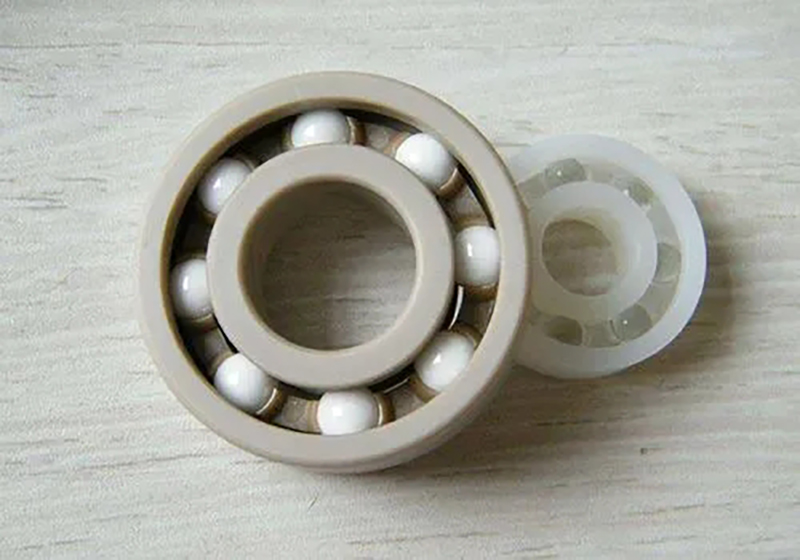
The classification of plastic bearings can be summarized from the following aspects:
1. Working principle classification:
(1) Plastic rolling bearings: The friction that occurs during operation is rolling friction. The size of rolling friction mainly depends on the manufacturing accuracy.
(2) Plastic sliding bearings: Sliding friction occurs during operation. The magnitude of sliding friction mainly depends on the material of the bearing sliding surface.
2. Material properties classification:
(1) POM plastic bearings: POM material has good mechanical strength and wear resistance, and is suitable for making relatively precise plastic bearings. The working temperature ranges from -60℃ to 100℃. POM plastic bearings are the most widely used of all plastic bearings.
(2) PP plastic bearings: Similar to POM materials, they also have good mechanical strength and wear resistance.
(3) Nylon bearing material: a cheap material with low friction factor, strong self-lubricating properties, and an operating temperature of up to 120°C.
(4) PTFE bearing material: The friction factor is the smallest, and when the load increases, the friction factor decreases accordingly, and the operating temperature is relatively high.
(5) Phenolic bearing material: high strength, high temperature resistance, but large friction factor and rapid wear.
(6) Acetal bearing material: The lowest price, extremely low dynamic and static friction coefficients against steel, and high strength and stiffness.
3. Application scenario classification:
(1) Precision plastic bearings: The precision and tolerance are improved compared to traditional plastic bearings, and they are suitable for precision and higher-speed operation.
(2) Anti-corrosion plastic bearings: They can still operate freely even in the most severe acid/alkali/salt/solvent/oil/gas/seawater erosion, ensuring ideal durability and life expectancy.
(3) Acid and alkali resistant plastic bearings: can be used in relatively weak acid-base cross environments. Specific materials such as PVDF and PTFE can be used in strong acid and alkali environments.
4. Structural classification:
(1) Plastic sliding bearings: Not only can they be made into the shape of a bushing, they can also be made into plastic linear sliding bearings, but the premise is that the material made of them must be self-lubricating to improve its overall wear resistance.
The classification of plastic bearings is mainly based on their working principles, material properties, application scenarios and structures. In practical applications, selecting the appropriate plastic bearing type is crucial to ensuring efficient and stable operation of the equipment.