


 The automobile industry is an important pillar industry in my country, and occupies a place that cannot be ignored in the entire processing and manufacturing industry. Bearings can be seen in many parts of the car body, which have special missions to bear loads, reduce friction, and guide moving parts. With the continuous improvement of my country's economic development and industrial technology, China has become a major bearing production country including automobile bearing steel, but there is still a big gap with first-class manufacturers such as Schaeffler in Germany, SKF in Sweden, TIMKEN in the United States, and KOYO in Japan. As the source, the direction of future efforts is still to strictly control the quality of metallurgy, the level of non-metallic inclusions, the size and distribution of carbides, and improve the level of heat treatment technology.
Heat treatment is a key process in the manufacturing process of automobile bearings, and its processing quality and raw materials are two important factors that affect the life of bearings. Heat treatment has an important influence on the microstructure, mechanical properties, surface quality, dimensional and shape accuracy and stability of bearings and other parts under service conditions. The best comprehensive performance adapted to the failure mode is an important topic of heat treatment technology.
1. Application of bearing materials in automobiles
As we all know, bearings are composed of four parts: outer ring, inner ring, rolling elements (balls, cylinders, cones or needle rollers, etc.) and cages. Some of them have sealing rings. The manufacturing material is mainly bearing steel.
When selecting the type and model of automotive bearings, it is mainly based on the nature, direction, size, and working environment of the actual part of the load, as well as the requirements for the rigidity, limit speed, life, and accuracy of the bearing, and is generally completed by the designer. Bearings are widely used in vehicles and vary with vehicle types, installation locations and manufacturers, as shown in Figure 1.
The author has visited some important domestic automobile bearing suppliers, such as Shanghai Renben, Zhejiang Wanxiang Seiko, Hubei New Torch, Changzhou Guangyang, Luoyang Dongsheng, Chongqing Changjiang, etc. The following only combines the automobile power system (alternator in the engine) , air conditioner electromagnetic clutch, tensioner and idler bearings), drive system (shaft gears in gearboxes, differentials, clutches and other bearings), hub bearings and other related products are briefly introduced.
(1) Power system bearings
The engine is the heart of the car, continuously providing power for other components. The internal bearings were previously dominated by sliding bearings. At present, most of them use sealed ball bearings on the premise of improving bearing performance. Figure 2 shows several typical bearings in engines.
Alternator bearings are single-row sealed ball bearings, which are mainly subjected to centripetal force. They are required to operate reliably even when the speed exceeds 2000r/min and the temperature exceeds 180°C. The rings and rolling elements are made of high-purity GCr15, and the hardness after heat treatment is required to be 58. ~64HRC, the cage is generally made of nylon PA46, and the sealing ring is generally made of acrylic rubber ACM, and the reference standard is JB/T8167-2006.
Air conditioner compressor electromagnetic clutch bearing is a double row angular contact ball bearing, the outer ring rotates, the speed of the air conditioner pulley can reach 7000~13000r/min, the maximum temperature is 160℃, the material is the same as above, and the cage is changed from a common single spherical pocket to a part For cylindrical surfaces, the reference standard is JB/T10531-2005.
Tensioner and idler bearings are high-performance sealed ball bearings. The former acts on the loose side of the synchronous transmission belt, while the latter acts on the tight side of the synchronous transmission belt. The materials are basically the same as above. The cage can be engineering plastics, or 08 steel or 10 steel. Manufactured, the sealing ring is made of ACM or FPM (fluorine rubber), and the reference standard is JB/T10859-2008.
Water pump shaft bearings are generally double row ball bearings, and the radial dimension is smaller than ordinary bearings. It is essentially a double-supported bearing system with a simplified structure. The two supported bearings have no inner rings. The raceways of the rolling elements are directly made on the shaft. The outer rings of the two supported bearings are made into a whole. Both sides are sealed with seals. Its rollers are usually made of high-chromium bearing steel, and the shaft and outer ring are made of carburized steel or high-chromium bearing steel. The reference standard is JB/T8563-2010.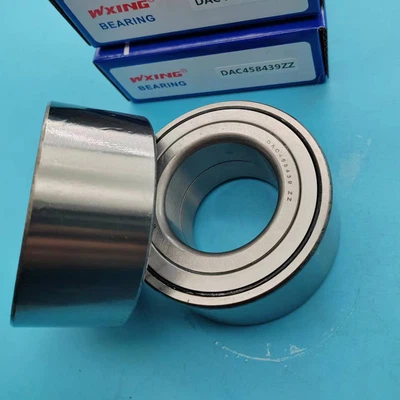
(2) Drive system bearings
The typical representative of the transmission system is the gearbox, which can be divided into manual (MT), automatic (AT), continuously variable transmission (CVT), dual clutch (DCT), etc., and it is also the part where the most bearings are used. There are often several bearings for different gears in the gearbox, and the main types are ball bearings, cylindrical roller bearings, tapered roller bearings, needle roller bearings, etc. The gearbox can be regarded as a gear box. There are often impurities (iron filings, burrs, sand inclusions, etc.) in the grease and anti-rust oil. The bearing rotates at a high speed during operation, resulting in a greatly shortened service life.
Figure 3 is a schematic diagram of the bearing position of our company's MA-type manual gearbox (see the blue marked part in the figure), in which the deep groove ball bearing 25D52E15 is used for one axis and one gear, and the deep groove ball bearing 25D62E17 for one axis and five gears. The first gear of the second shaft is cylindrical roller bearing 32D62E16, and the fifth gear of the second shaft is deep groove ball bearing 22D57E17.
Figure 3MA Manual gearbox and bearing position in differential
There are also two tapered roller bearings 38D63E17 in the differential, which are respectively located on the left and right sides of the differential case and installed on the seat hole of the reducer case, which bear and transmit the driving force of the differential and reducer , Reduce transmission friction resistance, improve transmission efficiency and reliability.
The rolling body and inner and outer ring materials of the above bearings are mainly GCr15, 100Cr6, SUJ2, SKF3, adopt overall quenching + low temperature tempering, heat treatment hardness 60~63HRC (rolling body requirements 60~64HRC), nylon cage material is PA46 +30%GF, the contact seal ring is ACM+SPCC, and the lubricating grease is Chevron SRI-2 (grease amount 2.0~2.8g).
The clutch release bearing, commonly known as the clutch tumbler, is located as shown in Figure 4. When the clutch pedal is stepped on, the pressure plate or drive plate bearing the spring thrust can move towards the direction of the clutch case, that is, the separation lever can be tilted to overcome the spring thrust of the pressure plate to The separation work of the clutch is mainly dependent on imports at present. The rolling body is 100Cr6, the material of the inner and outer rings is C67S (the minimum surface hardness is required to be 680HV), the cage is PA66+25%FV, and the seal is hydrogenated nitrile rubber HNBR. See standard.
3) Automobile wheel bearings With the improvement of the overall performance of automobiles, the requirements for the life, strength, stiffness and maintenance-free of wheel bearings are becoming increasingly stringent, and people are increasingly realizing the importance of lightweight, reliability, multi-function and modularization , Automobile hub bearings are developing towards a highly integrated direction. The automobile hub bearing unit has developed from the original ring locking type and cage locking type unit (first generation) to the second generation with a flange on the outer ring, and then to the inner ring with a large fill-in angle press fit The third generation of the flange can integrate the sensor with ABS and the flange, as shown in Figure 5. They are all double-row ball bearings to bear the greater load including the entire body. Most of the front wheel hub bearings in our company's existing models use the first generation, and the rear wheels use the third generation. For example, the material of the inner and outer rings of the hub bearing of a vehicle is SKF3, the material of the steel ball is SUJ2, the material of the flange is S55C, the material of the bolt is SCM435, the cage is nylon PA66+25%GF, and the combined sealing ring is NBR+SPCC/ NBR+SUS430.
2. Automotive bearing materials and performance requirements
 At present, automobiles are developing towards light weight, comfort, solidity, high power, compact structure, durability, good acceleration performance, and high reliability. In addition, due to the advancement of electronic control technology, automobiles are also developing in the direction of practical performance such as low energy consumption, simplicity and convenience, and strong operability. Therefore, rolling bearings, as important components for automobile support, must adapt to this trend.
During the service of automobile bearings, the unit area of the surface of the rolling elements and the rings has to bear a lot of pressure, which can reach up to 5000N/mm2 after calculation. When the bearings are running, they have rolling and sliding. In addition to being subjected to high frequency, alternating In addition to the contact stress, it is also affected by centrifugal force, as shown in Figure 6. According to literature records, the main failure modes of automobile bearings are peeling, pitting, adhesion, strain, fracture, loss of precision, excessive vibration and noise, etc. Therefore, the performance of bearing steel has the following requirements: ① High purity. ② low oxygen content. ③High hardness and wear resistance. ④ Good dimensional stability. ⑤ Adequate compressive strength and deformation resistance. ⑥ Good process performance.
Bearing steel is one of the important special steel varieties. Its quality and performance largely reflect the metallurgical level of a country. Automobile bearing steel accounts for about 40% of the annual output of bearing steel, and the consumption is large. Although the life and reliability of automotive bearings have a certain relationship with the initial design, manufacturing, lubrication, installation and maintenance, raw materials are the key.
It can be seen from the above that among the several major components of the automobile bearing assembly, except for the fact that the cage is changed from the original stamping steel to the popular nylon material (such as injection-molded PA66+30%GF) and the seal is more often made of rubber material ( Such as ACM+SPCC, NBR+SUS430), the rolling elements and inner and outer rings of automobile bearings in China use a large number of high-carbon chromium-containing bearing steels containing wC=0.95%~1.05%, wCr=1.40%~1.65%, In order to improve the hardenability to meet the needs of changes in the wall thickness of parts, a series of high-hardenability high-carbon chromium bearing steels can be developed by increasing the Mo content: such as 100Cr6 and 100CrMo in Germany, SKF2 and SKF3 in Sweden, and 52100.3 and 52100.4 in the United States , Japan's SUJ2, SUJ3, SUJ4, SUJ5, etc., are suitable for martensitic quenching, and are also suitable for bainite quenching of ultra-thick-walled bearing parts. There are slight differences in chemical composition between them, as shown in Table 1. The comparison between the two , In fact, these steel grades can be regarded as variants of GCr15.